Faculty Achievement View More Faculty Achievements
Recognition
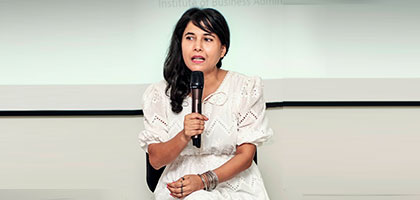
Professor at the SMCS, shares her insightful reflections on the significance of mathematics and its enduring impact on science, technology, and society on the occasion of International Mathematics Day.
The famous physicist Albert Einstein once said, “Pure mathematics is, in its way, the poetry of logical ideas.” Whether you are a mathematician or not, you will agree that nature is written in the language of mathematics. We may dislike math in our daily lives, but we cannot escape it. Whether you are a cook or a carpenter, a musician or a gardener, a data scientist or a physicist, a chemist or a biologist, a peasant or a president, a banker or a CEO, you all need mathematics in your lives.
The history of mathematics is extensive, encompassing multiple civilizations and stretching across millennia. The Egyptians were among the first to have used math. The Sumerians were the first civilization to have developed a counting system. The ancient Sumerians and Egyptians used arithmetic and geometry to solve practical issues like measuring land and calculating taxes.
The foundations of elementary mathematics were laid by mathematicians such as Euclid, Archimedes of Syracuse, and Apollonius of Perge. Much of their work was motivated not just by abstract curiosity, but by the desire to understand the natural world. Archimedes, for example, studied statics, levers, and buoyancy - problems we now consider physics - and expressed them mathematically.
Apollonius’ work on conic sections later became essential for astronomy and mechanics. In fact, many of the mathematical ideas that form the foundation of what we now call pure mathematics were developed either to describe physical laws or directly by physicists themselves. Physics, in a sense, existed as philosophy before it was formalized mathematically, and by creating the language of mathematics, these early thinkers transformed observations of nature into precise, predictive science. Their discoveries also enabled practical applications, such as building larger ships, showing how mathematics and physics grew hand in hand.
Mathematics continued to evolve during the Middle Ages, with advancements made in both Europe and the Islamic world. The 8th to the 15th century is considered the golden age of Muslim learning. Muslim mathematicians played a vital role in the development of algebra, trigonometry, and numerical analysis. European mathematicians, on the other hand, expanded upon the work of the Greeks, refining calculus and algebra. One noteworthy 9th-century Persian mathematician was Muhammad Ibn Musa al-Khwarizmi, who is often referred to as the father of algebra. Omar Khayyam, another scholar of the time, discovered a geometrical method of solving cubic or third-order equations, while Al-Biruni laid the groundwork for modern trigonometry. Another noteworthy 9th-century mathematician and astronomer, Al-Battani, was responsible for computing the first table of cotangents.
Mathematics underwent intermittent advancements until the Renaissance period. During this time, mathematical innovations intersected with new scientific discoveries, resulting in a surge of research that has persisted to the present day.
For physicists, mathematics and physics are deeply intertwined. Mathematics is not just a tool for describing the universe; it is the language in which the laws of nature are expressed. Henri Poincare wrote, “It is through mathematics that we penetrate into the hidden laws of the universe.” Roger Penrose has also said, “Mathematics is the language of nature.” At times, the distinction between the two is so subtle that they appear inseparable.
From the Google search engine to cryptography, from medical imaging devices to artificial intelligence, from machine learning to decoding the human genome, from taking a picture of a black hole to controlling the spread of COVID, from creating reliable electoral systems to the control and management of floods and hurricanes, mathematics has played a vital role and it is safe to say that math is indispensable for science, technology and humanity.
اورتاریخ ہمیں سکھاتی ہے کہ ریاضی یا طبیعات کسی ایک قوم کی میراث نہیں ہے۔ اس کو کرنےکےلیےصرف دیدۂ بینا اور ذوق آگہاہی چا ہیے۔
Recognition
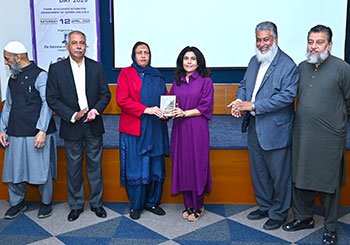
IBA Faculty Awarded IEP Trailblazer Award at Women’s Day Celebration
Dr. Shabana Nisar, Professor, Department of Mathematical Sciences, IBA-SMCS, was honored with the IEP Trailblazer Award for her outstanding achievements and unwavering commitment to women’s rights and empowerment. The award was presented during the Women’s Day celebration organized by the Institution of Engineers Pakistan.
We congratulate Dr. Shabana Nisar on this remarkable recognition and wish her continued success in her future endeavors.
Recognition
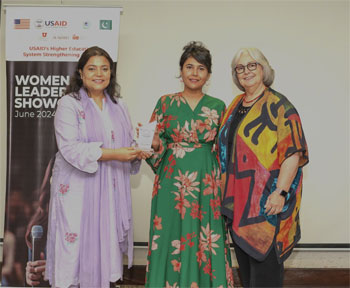
IBA faculty awarded Outstanding Academic Achievement Award at HESSA’s Women Leadership Showcase
Dr. Shabana Nisar, Associate Professor, Department of Mathematical Sciences, SMCS, has been honored with the Outstanding Academic Achievement Award at the HESSA’s Women Leadership Showcase held in Islamabad. The award was presented by Professor Susan Carvalho, Associate Provost and Dean of the Graduate School, University of Alabama.
We congratulate Dr. Shabana Nisar on this remarkable achievement and wish her success in her future endeavors.