Faculty Achievement View More Faculty Achievements

Published Works
The Revival of Ijtihad: Muslim Women’s Sport Participation and Leadership Through the Lens of PAR
Journal:
Asian Journal of Sport History & Culture
Abstract
Extant discourse on Muslim women in sport has largely been dominated by Eurocentric epistemologies that often portray them as passive and sometimes as monolithic subjects without any personal agency. Moreover, there exists a dearth of sport scholarship on how Islamic principles can be integrated with critical qualitative research methodologies to challenge the extant discourse. In this conceptual paper, the authors discuss how the lens of Participatory Action Research (PAR), with a particular emphasis on the concept of Ijtihad (a dynamic Islamic jurisprudence), can help scholars highlight Muslim women’s localized feminist resistance within sporting contexts. Based on the authors’ previous investigations in the Islamic Republic of Pakistan, alongside a broader historical understanding of Islamic jurisprudence, it is suggested that in certain contexts, Muslim women face intersectional challenges in sport settings, including gendered socio-religious norms, sectarian dynamics, and forms of systemic exclusion in sport governance. Nevertheless, Muslim women employ diverse contextual strategies through their understanding of Islamic norms (e.g., adoption of anonymity and leveraging Islamic history). Therefore, a paradigm shift in sporting research is warranted that prioritizes a nuanced understanding of localized Islamic feminism while integrating feminist discourse with the historical Islamic jurisprudence to foster more contextually relevant analyses.
Available online here.
Published Works
IBA Faculty Co-authors a Paper on Cricket, Culture, and Loyalty
Dr. Nida Aslam Khan, Assistant Professor, IBA-SBS, co-authored a paper titled 'Cricket, culture, and loyalty: the passion for Karachi Kings despite poor performance' published in the International Journal of Sport, Business and Management.
Abstract
Purpose
This study explores the factors that contribute to fan loyalty for a losing sports team, with a specific focus on the Karachi Kings in the Pakistan Super League. The research aims to uncover the motives that influence fans' unwavering support for a team that consistently underperforms.
Design/methodology/approach
A qualitative research design was utilized, involving semi-structured interviews with a diverse sample of Karachi Kings fans. Data were analyzed using grounded theory principles to uncover key themes. This approach allowed for an in-depth understanding of the underlying psychological and sociocultural factors. Grounded theory was chosen to systematically generate insights from data, particularly because fan loyalty in current contexts remains underexplored.
Findings
The research identified five main themes that influence fan loyalty: identity integration, emotional attachment, cognitive coherence, behavioral consistency and social connectivity. Fans exhibited a strong psychological connection to the Karachi Kings, fueled by regional pride, shared experiences and a sense of community. The findings emphasize the importance of creating a strong fan community and nurturing emotional bonds through consistent engagement and shared experiences.
Originality/value
This study demonstrated how psychological and sociocultural factors combine to sustain support for a losing team. It broadens the understanding of sports fandom by emphasizing that fan loyalty extends beyond a team's success or failure, being deeply rooted in identity, emotions and social connections. This research offers a nuanced view of fan behavior in a non-Western context and provides valuable insights for developing marketing strategies and fostering community engagement in sports management.
The full paper can be accessed here.
Recognition
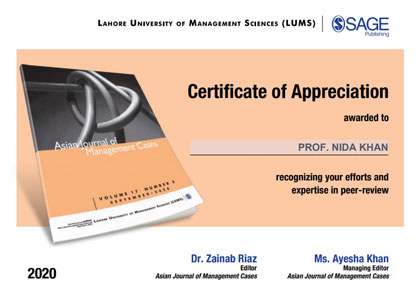
IBA faculty recognized for outstanding service for renowned journal
Dr. Nida Aslam Khan, Assistant Professor, Department of Marketing, was recently recognized by Lahore University Management Sciences (LUMS) for her outstanding services as a reviewer for the Asian Journal of Management Cases (AJMC). The contribution, dedication, and expertise of reviewers like herself have ensured that each case published in AJMC meet the high standards of the peer review process. With the increasing number of manuscript submissions this year, her timely reviews were vital to the ongoing success of AJMC.